Monday, August 5, 2019

Mexicali Rose: Tooled Leather Designs in Early California, Fact and Fiction


A.
I am a great admirer of Jo Mora as an artist, an illustrator, and an author. I really love his work and have for many years. However, I also believe that he is the source of quite a few misconceptions about early Californian material culture. One in particular is his interpretation of the kinds of leather tooling patterns seen in early California.

B.

Even though Mora must have had many opportunities to observe early examples of leather tooling that were present in museums, missions, and private collections, in his artwork he usually showed designs based on the kinds of work available in the 20th century - especially those featuring rambling, free-form compositions of naturalistic roses and foliage. See for example his illustration, "Juez de Campo," from his masterpiece work, "Californios, The Saga of the Hard-Riding Vaqueros, America's First Cowboys," (1949).

C.

I grew up in California and remember seeing this kind of work many times, particularly on a purse my mother bought in Tijuana in the 1940s. I still have that purse, though not a photograph of it. But it is very similar to the one I show here. Apparently Santa Barbara was also a center of this style of tooling by at least the early 1900s.

D.

However, I am convinced that very different styles of tooling were in use in Mexican era California (1822-1847) than the ones Mora so loved. The compositions found on imported items such as saddles and botas were much more stylized, often fitting into the framework of boundary lines and the motifs included symmetrical flowers, tear-drops, crescents, etc.

 E.

The rambling, naturalistic designs shown by Mora simply do not appear to have existed in either Mexico or California at this time, and probably nowhere else in the Hispanic West.
Shown here are a Sinaloan saddle said to date to the 1840s, but from the first half of the 19th century, more or less, I believe [https://www.cowanauctions.com/lot/mexican-sinaloa-saddle-on-a-jineta-pattern-tree-ca-1840-180253], my drawing of a bota in the collection of the Natural History Museum of Los Angeles County (Sutter's Fort Costume Manual), and a coraza in the collection of Monterey State Historic Park.
Even simpler, more stylized designs are found on tooled leather that appears to have been made in "ante Gringo "California. More about that soon.

Images:
A. "Juez de Campo" by Jo Mora (1949)
B. Sinaloan Saddle, circa 1850 - Cowan's Auctions
C. Vintage Mexican Leather Purse, circa 1950
D. Imported Mexican Bota (Legging) - Sutter's Fort Costume Manual.
E. Tooled and Embroidered Saddle Cover (Coraza), Probably Mexican before 1860 (California State Parks)

Thursday, August 1, 2019

A Smile of Recognition

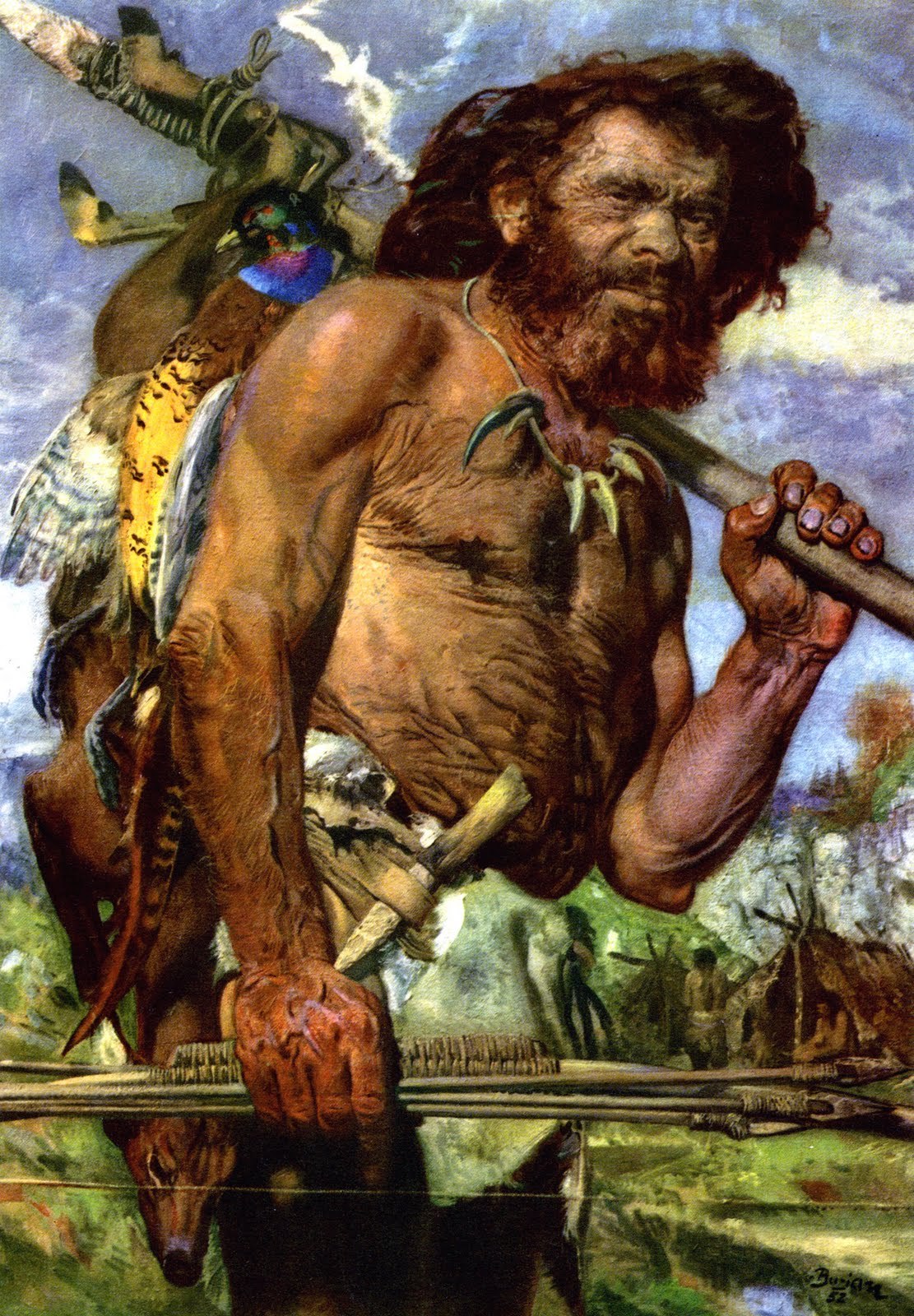
 I've seen their work for years and admired it, but until I ran across their names in an old New York Times magazine article, I never put all of their work together. They are Adrie and Alfons Kennis, Dutch, and identical twins who produce the most lifelike and humane interpretations of prehistoric humans and other animals.
More than just exceptionally talented artists, they bring a humanity to this subject that I find extraordinary. There have been many others who have done this kind of work. I'm thinking especially of Zdeněk Burian, the Czech artist whose work must have helped inspire these two http://www.bpib.com/illustrat/burian.htm.
But few of them ever thought to have our earliest ancestors smile at us, as if in recognition.
The article describes the twins as "Hyperactive. Like rubber balls." And that energy seems to affect their work, as they fold layers of detail into every wrinkle, pore, and scratch on their figures.
They have also absorbed huge amounts of information about how non-modern societies around the world stand, sit, arrange their hair, paint themselves, and so on.
"All this variation!" Adrien shouted at the author of this article. "It's beautiful!"
After leaving the two, the author wrote, "It only registered later: I had spent the day with identical twins who, since childhood, have been stupified by how different human beings can be."
Here is a link to their website. I could hardly stop looking. http://www.kenniskennis.com/site/Home/

Sunday, October 21, 2018

The Clothing of early California


I was in Sacramento on Wednesday to have a meeting about the historical clothing books I'm creating for California State Parks. We're getting close to publishing volume 1, "The Mexican Era, 1822-1847." It will be a history of all of the clothing worn in California except traditional Native American. There will be 13 chapters divided into three sections: A. Paisanos (Californios, Franciscans, Native Californians, and Soldados); B. Newcomers (Colony Ross, Mountain Men, Hudson's Bay Company, Merchant Seamen, and Euro-American); and C. California Conquest (US Navy, Marines, Army, and Volunteers). Each chapter will have an overview of the clothing or uniforms, with detailed color plates by me, eyewitness images and descriptions, additional drawings by me, and a bibliography. In addition, there will be three appendices: Clothing California (how California acquired its clothing, fabrics, news about fashion, etc.); Goods for Sale (a list of things you might have been able to purchase in California during this era); Horse gear (Californio and American made "Spanish" saddles, Euro-American (English and "Hybrid" saddles), and Native American (used by HBC and trappers). And, finally, there will be an extensive glossary of terms used in the book with definitions of fabrics, trims, horse gear, garment types, etc.


Volume 1 will come out in the first half of 2019.

Volume 2, which should also be out next year, will cover the early American period, 1848-1860, which will be mostly Euro-American clothing worn by immigrants, miners, gamblers, dance hall girls, craftsmen, etc. There will also be chapters on entertainers, Californios, Native Californians, and the so-called "foreign" miners including the Chinese, Chilean, Malays, Hawaiians, etc.
Volume 3, also out next year, is about living history in California State Parks - how it developed, what it is today, how to organize and maintain living history programs, etc.

The illustrations I am creating are still in the development stage. I'm including two of my sketches with mocked-up captions, and just a peek at one of the finished color plates - Californio vaqueros of the 1820s - 1830s.

Monday, September 3, 2018

Anquera to Anquerita

A.

The subject of anqueras came up yesterday on "Alta California Material Culture" page on Facebook. 

https://www.facebook.com/groups/743829595948040/

B.

Anqueras are leather rump covers that usually are edged with metal jinglers. They are believed to be descended from the horse armor used by Medieval and Renaissance Era cavalrymen in Europe and brought to the New World by the conquistadors. But in Mexico they were popular with civilian horsemen, too. It's hard to say why. Some declare that it is useful in training a horse to lift up its hind legs. I really don't know.
C.

Perhaps because the jinglers started showing up in archaeological sites in the Southwest, there was a general idea that soldados de cuera used the full, rump-covering anqueras and, from at least the 1960s, a number of artists showed them on their reconstructions of mounted presidial cavalrymen. However, I haven't seen any evidence for the use of full anqueras by anyone in the Spanish Borderlands in the 18th and 19th centuries, though they lingered in civilian use into the late-1800s and are seeing a revival today.

https://www.brionatural.com/…/8-art…/49-el-uso-de-la-anquera

D.

Instead, by at least the beginning of the 18th century, a smaller rump cover was used, just covering the horse's croup - the top of the rump. They still used the same sort of jinglers as the large anqueras - which is probably why they've been found in Southwestern archaeological sites.


  E.

The defensive usefulness of the anquera disappeared long before they were completely abandoned by presidial soldiers. After all, why a rump cover but nothing for the horse's chest? But, by 1800, anqueras appear to have been largely abandoned by the military. In civilian use, however, the anquera lingered on into the early 1860s as the "anquerita," which served no real purpose except, as some eyewitnesses declare, a place for the caballero to sit when he rode with a lady sitting on the saddle proper. 

 F.

Images:
A. 1834 ca. "The Hacendero and His Mayordomo," by Carl Nebel. From, "Voyage pittoresque et archéologique dans la partie la plus intéressante du Mexique," (Paris, 1836).

B. Anquera for sale on the Michael D. Higgins Antique Indian Art website (viewed Sept. 3, 2018):https://mhiggins.com

C. Reconstruction of a soldado de cuera by José Bueno found online. Original source unknown.

D. Soldier from the Presidio of Monterey, California, attacking native peoples, drawn by José Cardero, 1791 - Museo Naval, Madrid.

E. Watercolor of a presidial cavalryman painted to illustrate a report by Raimundo Murill, 1803. Archivo de las Indias, Spain.

F. "Californian Catching Wild Horses with Riata, by Arthur Nahl, 1859 - Oakland Museum of California.

Sunday, May 6, 2018

History and Truth


Today someone posted this on a friend's Facebook page:

"This has always been my problem with history. It's so distorted. I find it hard to trust."

I and others like me who love history must always feel a little disappointed when we encounter those who believe it is distorted and untrustworthy. All branches of knowledge change over time when new data or new ways of interpreting that data, emerge. Even the hard sciences such as chemistry or geology - even physics, which is mostly understood through advanced mathematics, is hotly disputed. Albert Einstein had quite a lot of trouble accepting the new quantum theories that we take for granted today. 

If someone is looking for absolute truth in any branch of knowledge, they won't find it. Yet I believe that each honestly reasoned attempt we make to understand things, even history, based on evidence, advances us that much farther . . . if not toward absolute truth, then at least toward a better understanding.

Image: c1770 limestone relief  of Clio, the muse of History. From Plas Llangoedmor estate, Cardigan, Wales. http://salvonews.blogspot.com/2010/03/alex-puddy-over-moon-at-853k-christies.html

Thursday, May 3, 2018

A True Espada Ancha


A.
Several months ago I was asked by the museum at Mission San Juan Capistrano in California to help them find and direct craftspeople to make replicas of the kinds of arms used by the Spanish presidial cavalry in the late 1700s - the kinds of men who would have formed the cuartel, or guard, at the Missions. These replicas will be a part of a new exhibit at the museum. https://www.missionsjc.com

 B. 

I've enjoyed working on this project, which is directed by Megan Dukett, the Education and Interpretive Program Director at San Juan Capistrano, and seeing the amazing creations of the artisans. The first replica to be completed is this copy of a Model 1728 Spanish Cavalry broadsword - the kind of weapon used by Spanish frontier soldiers across the West, from Texas to California. Its creator is John Logan, a skilled craftsman and owner of Iron John Logan, specializing in fine blacksmithing, woodworking, and leather. I provided the research information, but John provided the artistry. http://ironjohnlogan.comhttps://www.facebook.com/ironjohn.logan

 C.

D
There has long been confusion about the meaning of the Spanish term espada ancha, though I cannot understand why. Many years ago it became attached to Mexican short swords that were usually carried on the saddle. Espada, of course, means "sword," and ancha means "wide" or "broad." So, a literal translation is quite simply, "broadsword," not "shortsword." In fact, from period literature we know that these short swords were called machetes - and still are by Mexican horsemen. 


 E.

The late, and great, historian Sidney Brinckerhoff, seems to have had a part in this confusion of terms by misnaming these short machetes espadas anchas in his classic study, with Pierce A. Chamberlain, Spanish Military Weapons in Colonial America 1700-1821 (Stackpole Books, 1972).  Some years ago, in an exchange of email messages with Sid, I asked him about this. I still have a printed copy of his reply to the effect that he really didn't remember why he'd called these swords espadas anchas - an open and honest reply typical of the man.


 F. 

There is evidence that short swords were carried by some provincial units in Mexico, such as the Lanceros de Veracruz, but the swords of the soldados de cuera seem always to have been the espada ancha - the full size broadsword.


 G. 

A soldado de cuera in late-Spanish Era California, José Amador, said in his oral history, recorded in 1877, that his unit's swords were  "four to five Flemish spans long" (cuartas flamencas), long enough for the officers to use them as walking sticks. 


 H. 

Since each presidio was required to arm and equip itself, the Model 1728 cavalry broadsword was not the only weapon used by the soldados de cuera, but it seems to have been one of the most common, with fragments discovered at archaeological sites across what once was Spain's Provincias Internas. Other kinds of swords purchased by presidios included the Model 1799 cavalry broadsword, and cup hilted swords. In the uncertain and underfunded supply system of the northern frontier, it was not unusual to find regulation sword blades with non-regulation hilts, and vice versa. But likewise, it was not uncommon to find examples of the light, well-balanced, and sturdily made Model 1728 broadsword still in use by presidial soldiers half a century and more after the manufacture date inscribed on their blades. 

 I.


J. 

Through this new exhibit, and the artistry of John Logan, we now have a proper example of the kind of weapon Spain's frontier soldiers long relied upon, and an opportunity to correct a longstanding error of identification. 

Images:
A., D., I, and J. The replica M1728 Spanish cavalry broadsword created for Mission San Juan Capistrano's museum by John Logan. Note the attention detail, including the braided copper wire grip and the engraving on both sides of the blade, copied exactly from original examples. John also "aged" the sword slightly so that it wouldn't look too new.

C. An original M1728 Spanish cavalry broadsword, Arizona Historical Society.

E. A machete used to illustrate the article "Espada Ancha: Swords of Mexico and Spanish Colonial America," Viking Sword website. http://www.vikingsword.com/ethsword/espadaan/index.html

F. A Lancero de Veracruz, 1769. This soldier of a provincial unit carries a short sword, a machete, on a shoulder belt.

G. A soldier of the Regimiento Provincial de Caballeria del Rey, ca. 1771 carries a full length sword, quite likely the M1728 broadsword..

H. José Cardero's portrait of a presidial soldier of Monterey, California, 1791. Note that he carries a full size sword but with a cup hilt.


Wednesday, May 2, 2018

Botas, Part 1

A.

I have studied Mexican leggings - botas - for decades. I've handled dozens of examples from the first half of the 19th century, and examined eyewitness drawings, paintings, read eyewitness accounts, and looked at early photographs. Needless to say, I've photographed many original pieces. Sad to say, though, I can't share any of these photos because of the agreements I have with museums and collectors not to publish their collections without permission and, sometimes, payment.

B.

C.

D.

However, when the antiques dealer, Michael D. Higgins, publishes photographs online of a single bota he has for sale, I feel that not only is it alright to do so, but that I'm helping him to publicize his website:  http://mhiggins.com/items/early-mexican-leather-bota/


E.

F.
This bota is a good example of the kind that was mass produced in Mexico and often traded into Texas, the Southwest, and California. Gringos liked them, too, though they tended to wear them backwards. That is, with the flap pointing toward the heel rather than the toe, as vaqueros wore them.

G.

H.

All of the Mexican and Hispanic-American botas I've ever examined, or seen in photographs, are made of suede leather. I've never seen grain leather used anywhere. The botas imported from Mexico are made of a substantial, but very flexible, leather - sueded on both sides, similar in feel to chamois but thicker, and dyed a light or dark shade of rust brown. These usually have patterns on them that appear to be tooled, but may have been mass produced with a device similar to a printing press. Sometimes, they have embroidered panels sewn to them - they are not themselves embroidered. And some are bound around the outside edge, often with a silk ribbon, usually green.

I.

I have never seen any evidence, either written or visual (artwork or photographs) of other sorts of decorations, including conchas, loops, fringes, etc. 

I'll have more to share on botas another day.

 Images:
A. In "Native Californians Lassoing a Steer," by Auguste Ferran, ca. 1850, we see vaqueros in their everyday and working dress. It is difficult to tell if their botas are imported or homemade, though the shape and the color of those worn by the two mounted men, at least, suggest imported. Note how the "wing" of the bota points toward the toe. [Bancroft Library, University of California, Berkeley]

B., C., D. G., and H. A single bota currently for sale by Michael D. Higgins. This legging is very typical of Mexican manufactures that were sold both domestically and as exports, chiefly to Hispanic communities in Texas, New Mexico, Arizona, and California.

E. Daguerreotype of Docia and Aaron Tyner, who moved to California from Arkansas in 1852. Photograph ca. 1856-1858. By his ribbon chinstrap and his suede botas, probably imported, Aaron Tyner displays the kinds of vaquero clothing frequently adopted by Anglos who moved to California during the Mexican Era and Gold Rush. Notice that the wing of the legging is wrapped so as to face backwards, toward the heel - the opposite of how vaqueros wore them. The original photograph is in the Kings County Museum, California. It was published in Joan Severa's Dressed for the Photographer, (Kent State University Press, 1995)

F. In "Costume of Upper California," an illustration in the Atlas Pittoresque of Abel Du Petit Thouars, 1837, we see the reddish brown legging wrapped so that the wing points forward, toward the toe. This is how they were worn in Mexico and in Hispanic communities across the Southwest and in California.

I. Another bota of the kind manufactured in Mexico. It is "tooled" (possibly stamped using an etched plate and a press), but has an embroidered panel sewn to one wing only because, obviously, the other wing is hidden when the bota is wrapped around the wearer's calf.